
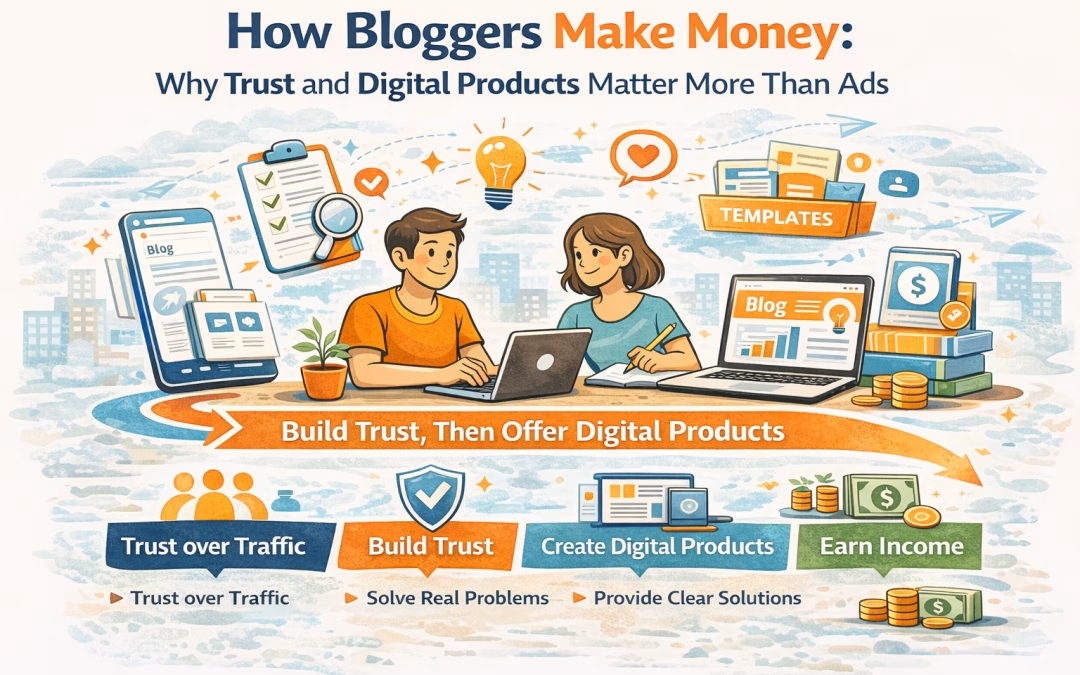
The Blog Monetization Lie Most People Still Believe
Most new bloggers start with the same assumption:
“I need traffic so I can earn from ads.”
It sounds logical. More traffic = more clicks = more money. But here’s the reality most bloggers learn too late:
Ads reward attention. Businesses reward trust.
And trust is where the real money is. If you build your blog purely around pageviews, you’re building a fragile income stream. But if you build it around trust, you’re creating an asset that compounds over time.
That’s the shift this post is about.
The Two Monetization Paths (And Why One Wins Long-Term)
There are two dominant ways bloggers make money:
1. The Traffic Model (Ads + Affiliates)
- Earn per click or impression
- Requires high traffic volume
- Income fluctuates constantly
- You rely on platforms and algorithms
2. The Trust Model (Digital Products + Services)
- Earn per relationship, not per click
- Requires deeper content, not just more content
- Income grows as authority grows
- You own the entire system
Here’s the uncomfortable truth:
Traffic is rented. Trust is owned.
Blogs are powerful because they let you build that trust over time. A well-written post can continue attracting and converting readers for years.
Why Ads Are a Weak Foundation for Most Bloggers
Let’s break this down clearly. Ads are not bad. They’re just limited.
The Problems with Ads:
- Low revenue per visitor
You need thousands of visitors to earn small amounts. - No relationship with your audience
You monetize attention, not connection. - Platform dependency
Your income depends on traffic sources you don’t control. - No leverage
Every increase in income requires more traffic.
Even worse, advertising content often blurs the line between value and promotion, which can erode reader trust if overused.
If your goal is a real business, ads alone won’t get you there.
The Real Business Model (Trust → Value → Digital Products)
This is not just a concept. It’s a repeatable system. Think of your blog not as a publishing platform, but as a conversion engine built on trust.
Step 1: Build Trust Through Specific, Useful Content
Most bloggers write broadly. That’s the mistake.
Trust is built through:
- Specificity
- Clarity
- Relevance
Instead of writing: “How to Make Money Online”
You write: “How to Turn 10 Blog Posts Into Your First Digital Product”
Why this works:
- It signals expertise
- It attracts the right audience
- It filters out low-intent readers
Trust increases when readers feel:
“This was written for me.”
Step 2: Turn Content Into Proof of Competence
Your content is not just information. It’s evidence.
Each post should demonstrate:
- How you think
- How you solve problems
- How you simplify complexity
This is what transforms you from:
- Writer → Authority
Practical Shift:
Instead of: “Here are 5 tips”
Do:
- Show process
- Break down decisions
- Share frameworks
Because people don’t buy tips. They buy clarity and confidence.
Step 3: Identify Repeating Problems (This Is Where Products Come From)
Your future product is already hidden in your content.
Look for:
- Questions you keep answering
- Topics you keep revisiting
- Comments or messages asking “how exactly?”
These are signals.
Simple Test: If you’ve explained something 3–5 times… That’s not content anymore. That’s a product waiting to happen.
Step 4: Package the Solution (From Content → Product)
Now you structure what you already know. You’re not creating something new. You’re organizing what already works.
Turn this:
Scattered blog posts
Into this:
- Step-by-step system
- Checklist or template
- Guide or playbook
Example Transformation:
| Content | Product |
|---|---|
| Blog posts on content strategy | Content planning template |
| Posts about blogging income | Monetization roadmap |
| Tutorials | Structured course |
The key principle:
People pay for organization, not information.
Step 5: Connect Content to Product (Soft Conversion System)
This is where most bloggers drop the ball.
They either:
- Don’t sell at all
or - Sell too aggressively
The right approach is contextual selling.
Every post should answer:
- What problem does this solve?
- What’s the next step for the reader?
Then naturally introduce your product as:
- The deeper solution
- The faster path
- The structured version
Example:
In your post:
- You explain the concept
Then you say:
“If you want the exact template, I’ve put it together here…”
That’s it. No pressure. Just alignment.
Why Digital Products Outperform Ads (Every Time)
Let’s compare directly:
| Factor | Ads | Digital Products |
|---|---|---|
| Income Model | Per click | Per solution |
| Control | Low | High |
| Scalability | Limited | High |
| Relationship | Weak | Strong |
| Long-Term Value | Low | High |
Here’s the key insight:
Ads monetize attention.
Digital products monetize transformation.
People don’t pay for content. They pay for outcomes.
The Compounding Effect Most Bloggers Miss
A blog post does more than attract traffic.
It:
- Builds trust
- Answers questions
- Pre-sells your ideas
- Positions your products
Over time, your blog becomes:
A system that turns strangers into buyers.
This is why blogging still works today. Not because of traffic. But because of compounding authority.
What This Looks Like in Practice
Let’s make this concrete. Instead of writing random posts like:
- “10 Tips for Productivity”
You build a structured path:
Example Content Flow:
- Awareness Post
→ “Why Most Productivity Systems Fail” - Education Post
→ “How to Build a Simple Daily System” - Implementation Post
→ “My Exact Daily Workflow Template” - Product
→ Sell the template + guide
This is how content becomes a funnel. Not in a manipulative way. But in a helpful, structured way.
The Shift You Need to Make (If You Want Real Income)
If you’re serious about making money from blogging, you need to shift from:
Old Mindset:
- “How do I get more traffic?”
- “How do I monetize clicks?”
New Mindset:
- “What problems can I solve?”
- “What can I package into a product?”
- “How do I build trust at scale?”
This is the difference between:
- A content creator
and - A digital business owner
At this point, you might be thinking:
“This makes sense… but how do I actually start?”
The good news is, you don’t need a complicated system. You don’t need funnels, ads, or a big audience. What you need is a simple, repeatable process that turns what you already know into something people are willing to pay for.
Here’s that process.
1. Pick a Problem (Start Smaller Than You Think)
Most bloggers fail at the very first step because they try to go too broad.
They say they want to write about:
- Blogging
- Productivity
- Making money online
But those aren’t problems.
Those are categories.
And categories don’t convert.
A real problem sounds more like this:
- “I don’t know what digital product to create”
- “My blog isn’t making money”
- “I have traffic but no sales”
When you choose a specific problem, something changes.
Your writing becomes clearer.
Your examples become sharper.
Your reader feels seen.
Instead of speaking to everyone…
You start speaking to someone.
And that’s where trust begins.
2. Create 5–10 Strategic Posts (Not Just Content, But Direction)
Once you’ve chosen a problem, the next instinct is to start writing anything related to it.
That’s another trap.
Because random content doesn’t build momentum.
It creates noise.
Instead, think of your posts as a guided path.
Each one should move your reader one step forward.
You’re not just publishing articles.
You’re building understanding.
One post helps them realize the problem.
Another shows them what they’re doing wrong.
Another introduces a better way.
Another shows them how to apply it.
By the time they’ve read a few of your posts, they shouldn’t just feel informed.
They should feel:
“Okay… I think I can actually do this.”
That feeling is what leads to action.
3. Map the Content Journey (Turn Posts Into a System)
Here’s where blogging starts to become a real asset.
Most blogs are just collections of posts.
But high-performing blogs feel different.
They feel connected.
Like no matter where you start, there’s always a “next step.”
That’s not an accident.
It’s designed.
When you map your content journey, you’re asking:
- What should someone read first?
- What should they understand next?
- What do they need before they’re ready to act?
You begin linking your posts intentionally.
Not just for SEO.
But for experience.
So instead of a reader landing, reading, and leaving…
They stay.
They explore.
They go deeper.
And with every step, their trust in you increases.
4. Extract the Product (Stop Creating, Start Organizing)
This is the part most people overcomplicate.
They think:
“I need to come up with a completely new idea.”
You don’t.
Your product is already there.
It’s inside the content you’ve been creating.
It’s the pattern behind your posts.
The repeated explanations.
The process you keep teaching.
Instead of creating something from scratch, you shift your thinking:
From:
- “What should I make?”
To:
- “How do I organize what already works?”
You take your ideas and:
- Put them in order
- Fill in the gaps
- Make it easier to follow
That’s it.
Because people don’t pay for new information.
They pay for:
- Structure
- Simplicity
- Speed
5. Build the Conversion Loop (Where Everything Starts to Compound)
This is where your blog stops being content…
And starts becoming a business.
At first, it’s simple.
Someone reads your post.
They find it helpful.
They try something you suggested.
Then they see your product.
And instead of feeling sold to…
It feels like the natural next step.
They buy.
They get a result.
And something important happens.
Trust deepens.
Now they don’t just see you as someone who writes helpful content.
They see you as someone who can actually help them get outcomes.
That’s when the loop begins:
- Content builds trust
- Trust drives purchases
- Results reinforce trust
- Trust leads to more purchases
Over time, this compounds.
You’re no longer chasing traffic.
You’re building a system where:
Each piece of content strengthens everything else.
Final Thought: Blogging Is Not About Writing
It’s about building trust at scale. Once you understand that:
- Traffic becomes a tool, not the goal
- Content becomes an asset, not output
- Your blog becomes a business, not a hobby
And the moment you stop chasing ads… You start building something that actually grows.
What You Should Do Next
If you’re starting from scratch:
- Focus on solving one clear problem
- Write content that teaches, not just ranks
- Think about products early, not later
If you already have a blog:
- Audit your posts
- Identify what builds trust
- Start packaging your knowledge
Because the real opportunity isn’t in more content. It’s in turning your content into income.