
There’s a quiet frustration most bloggers don’t talk about.
You publish consistently.
You try to be helpful.
You even get some traffic.
But when it comes to making money, everything suddenly feels unclear.
You start thinking:
- Maybe I need a better idea
- Maybe I need a completely new product
- Maybe I’m not ready yet
So you open a blank page… and nothing happens. Here’s the truth most people miss:
You are not lacking ideas. You are overlooking assets.
Your blog is not just a collection of posts.
It is a record of:
- Problems you’ve already explored
- Questions people are already asking
- Paths people are already trying to follow
And hidden inside that record are product ideas that are already validated.
The problem is not creation. It’s recognition.
The Shift: From Blogger to Digital Product Creator
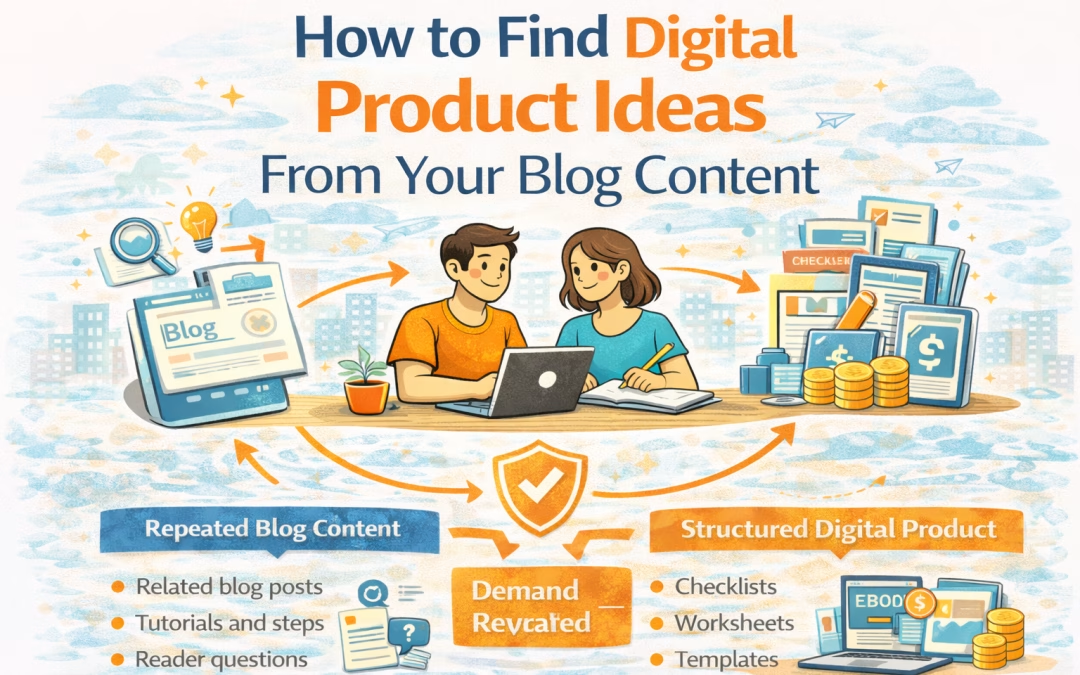
At the beginning, blogging feels like output. You write. You publish. You move on. But at some point, if you want this to turn into something sustainable, you have to change how you see your work. You stop treating your blog like a timeline…
…and start treating it like a library of solutions.
That shift changes everything. Because now, instead of asking:
“What should I write next?”
You start asking:
“What have I already solved that people would pay to shortcut?”
That’s the moment you stop being just a blogger. That’s when you start becoming a product builder.
Why Your Blog Is the Best Source of Product Ideas
Let’s be direct. Most digital products fail for one reason:
They were created in isolation.
No real signal.
No real demand.
Just assumptions.
Your blog protects you from that.
Because every post you publish creates feedback loops:
- Which topics attract attention
- Which ideas people stay on longer
- Which posts generate questions or confusion
These are not vanity metrics. These are buying signals in disguise.
When someone:
- Searches for a topic
- Clicks your post
- Reads through it
- Still needs more clarity
That gap between “content consumed” and “problem solved”…
That’s where your product lives.
The Content-to-Product System (Step-by-Step)
Step 1: Identify Your “Signal Posts”
Not all blog posts are equal. Some are just content.
Others are signals of demand. Your job is to tell the difference.
Look at your blog and ask:
- Which posts consistently get attention?
- Which topics keep coming back?
- Which articles feel like they could be expanded into something bigger?
These are your signal posts. They represent interest that already exists, not interest you’re trying to create.
What you’re really doing here
You’re not picking your favorite posts. You’re identifying:
“Where is the market already leaning in?”
That’s a very different mindset.
Step 2: Extract the Core Problem
Every valuable product is built around one thing: A clearly defined problem that people want solved now.
Your blog posts are surface-level answers. Your product will be the complete solution. So you dig deeper.
Instead of looking at titles, look at intent.
Ask:
- Why did someone search for this?
- What are they struggling with before they land here?
- What are they still missing after reading?
Example shift
A post says:
“How to Start a Blog”
But the real problem is:
“I’m overwhelmed and I don’t want to waste time doing this wrong.”
That emotional layer is what people pay for. Not just steps. But clarity and confidence.
Step 3: Group Content Into Product Themes
At this point, most people make a mistake. They try to turn one post into one product. That usually leads to weak offers. Instead, zoom out. Look for patterns.
Ask:
- Which posts naturally belong together?
- Which topics feel like steps in a journey?
Now you’re not building content anymore. You’re building transformation paths.
What this looks like in practice
You might notice:
- Post about starting
- Post about choosing niche
- Post about writing content
- Post about getting traffic
Individually, they’re helpful. Together, they tell a story:
“From zero to a functioning blog”
That story becomes your product.
Step 4: Choose the Right Product Format
Here’s where strategy matters. The format you choose should reduce effort for the user, not increase it. Think about how your audience wants to consume the solution.
A simple way to decide
- If your content is instructional → turn it into a structured guide
- If your content is repetitive → turn it into templates
- If your content is conceptual → turn it into a playbook
The real question to ask
“What format makes this easiest to apply immediately?”
Because convenience is value. And value is what people pay for.
Step 5: Validate Before You Create
This is where discipline comes in. You might feel excited about an idea. That doesn’t mean the market is. Validation protects your time.
Think of validation like this
You’re not asking:
“Do people like this idea?”
You’re asking:
“Will people take action around this idea?”
Those are very different signals.
Lightweight ways to validate
- Turn the idea into a blog post and track engagement
- Offer it as a free download and measure signups
- Add a simple call-to-action and track clicks
You’re looking for movement. Because movement means demand.
Step 6: Package the Outcome, Not the Content
This is where most creators undersell themselves. They describe what the product is… instead of what it does.
People don’t buy:
- PDFs
- Videos
- Templates
They buy:
- Speed
- Clarity
- Confidence
So instead of saying:
“10-page blogging guide”
You say:
“Launch your blog without second-guessing every step”
Same material. Different value perception.
The Content Flywheel (Where Momentum Starts Compounding)
Once you go through this process once, something clicks. You stop seeing content as one-time effort. You start seeing it as raw material.
Your system becomes:
- You write content
- You observe what performs
- You turn it into a product
- You use that product to grow your audience
- That audience gives you better insights
Then you repeat. This is where blogging becomes a business. Not because you publish more…
…but because every piece of content starts working twice.
Common Mistakes to Avoid
Let’s tighten this up.
- Creating Without Signals. If no one is engaging with the topic, it’s not ready.
- Overbuilding Too Early. Your first version should feel simple, even slightly incomplete.
- Ignoring What Already Works. If something is performing, lean into it. Don’t abandon it.
- Waiting for Confidence. Confidence comes after you launch, not before.
Your First Action Plan
This is where most people stall. So let’s make this practical and grounded.
Step 1: List Your Top 10 Blog Posts
Go to your blog analytics or just scan your content.
Write down 10 posts that:
- Get the most traffic
- Feel the most useful
- Cover foundational topics
Why this matters
You’re creating a shortlist of proven attention. You’re not guessing what works. You’re starting from what already does.
Step 2: Group Them Into 2 to 3 Themes
Look at your list and start grouping posts that naturally connect. Don’t overthink this.
Just ask:
- Which posts feel like part of the same journey?
Why this matters
This step transforms scattered ideas into structured direction.
Instead of random topics, you now have:
- Beginner path
- Growth path
- Monetization path
That’s how products are formed.
Step 3: Turn One Theme Into a Simple Product Idea
Pick just one group.
Then complete this sentence:
“This product will help someone go from ___ to ___.”
Example:
“From not knowing how to start a blog → to publishing their first blog with confidence”
Why this matters
This forces clarity.
If you can’t define the transformation, the product will feel vague.
And vague doesn’t sell.
Step 4: Test It as a Free Download
Before building anything complex, create a simple version.
This could be:
- A checklist
- A short PDF
- A mini guide
Then offer it inside your blog.
Why this matters
You’re testing behavior, not opinions.
If people download it:
→ You’re on the right track
If they don’t:
→ Adjust before investing more time
This step protects your energy and accelerates learning.
Final Thought: Your Blog Is Not Content, It’s Inventory
Every post you publish is something you can use later. Most people treat content like output. You need to treat it like inventory waiting to be packaged.
Because once you understand this:
- You stop chasing ideas.
- You start refining assets.
And that’s how you build something that grows over time.